

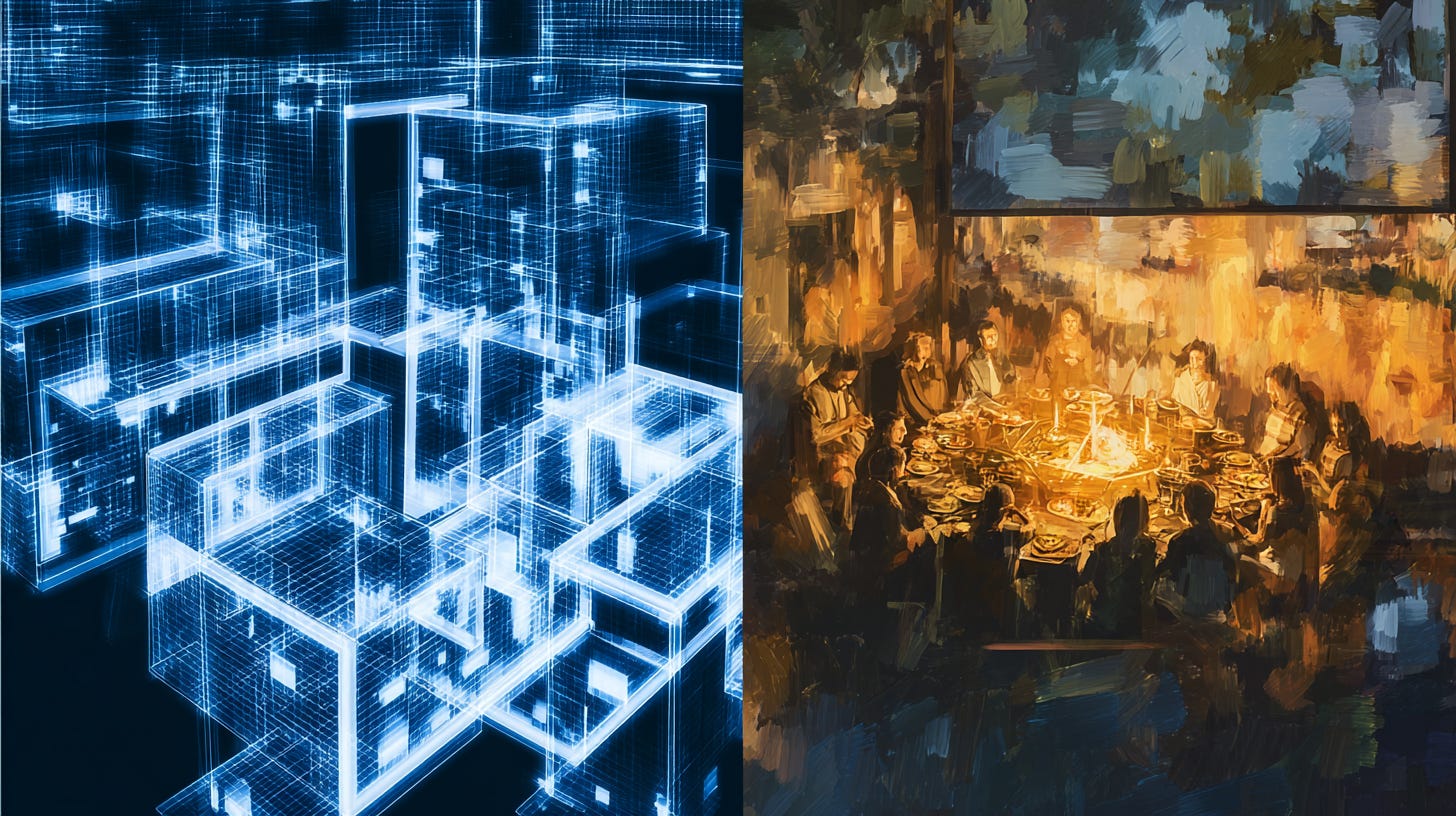
In the 80s, we learned early that there were two kinds of people.
Those who held doors open at the top of the stairs, and those who pushed through first, elbows sharp, already calculating the next threshold.
Madrid, 1994. Mortalaz.
The walls spoke in layers. Underneath the municipal grey, older voices. Underneath those, older still. A palimpsest of refusal that predated any of us by decades. Someone had written NADIE ES ILEGAL (No one is illegal) in red paint that had faded to the color of dried blood, and below it, in fresher black: SOLIDARIDAD O BARBARIE.(Solidarity or Barbarism)
They told us to compete. They told us this casually, the way you tell someone to pass the salt. As if it were the most natural thing. As if helping the person beside you was a weakness bred out of evolution, a vestigial impulse like the appendix, something to be surgically removed and forgotten.
The scheme worked like this: one at the top, pressing buttons. A tier below, the loyals, pressing different buttons on his behalf, believing themselves partners rather than instruments. Below them, another tier. And another. Each level convinced they were almost there, almost ascending, if only they could step on the fingers of whoever was climbing behind them.
A pyramid that produced nothing but its own perpetuation. That manufactured scarcity to justify hoarding. That called solidarity naive and competition natural, as though we hadn’t spent millennia surviving precisely because we shared fire, shared food, shared the watch through dangerous nights.
They want us to believe the walls are where they are for good reason. That the fences make sense. That the borders, the divisions, the lines between yours and mine, all of it is just how things are.
But the walls are new. The fences are new. The idea that you should let your neighbor starve because he didn’t work hard enough, that’s new. We’re old. What we feel when we help each other, that’s the ancient thing.
The bully operates through exhaustion. Through the slow erosion of the imagination.
He doesn’t need to convince you that his way is good. He only needs to convince you that alternatives are impossible. That to even dream of different arrangements is childish, unrealistic, a failure to understand how the world works.
And so we learned, some of us, that the only way to challenge this unsatisfactory situation was to become unrealistic. To breach realism’s heavily policed borders and surrender fully to unreality. To imagine so stubbornly that the imagining itself became a kind of action.
I think about the pyramid now, watching the news. The same architecture, scaled up. The one at the top, finger hovering. The loyals below, pressing their assigned buttons, convinced of their proximity to power. The vast base holding everything up while being told they are lucky to be included at all.
The walls are not geography. They are decision.
That scarcity is manufactured.
That when they tell you solidarity is naive, what they mean is that solidarity is dangerous. To them.
The paint on those Madrid walls has been covered over now. I checked, last time I was home. Municipal grey again. Clean. Orderly. As if nothing had ever been written there.
But the brick remembers texture. The city holds its fever underneath the skin.
And somewhere, I have to believe, someone is pressing their palm against a wall right now. Feeling the cold transfer through skin. Feeling the letters that were painted over but never really erased.
Solidaridad o barbarie.
You choose.
I always believe scarcity shows the true colours of people. The twisted thing is capitalism and governments have encouraged that competitiveness and individualism, making it hard to keep opening doors to others.
This captures the tension between imposed competition and the enduring human instinct for solidarity